
Originally published in 2015 on my personal blog, Beyond the Hero’s Journey explored four alternative narrative structures to Joseph Campbell’s infamous monomyth. It attracted 100,000+ readers and continues to circulate widely. What follows is the original article, lightly edited, and a coda for 2026.
Roland Barthes, master linguist and semiotician once said: “There are countless forms of narrative in the world.” And yet the majority of western storytellers have been ploughing just one narrative framework for over 60 years: Joseph Campbell’s Hero’s Journey from the Hero with a Thousand Faces.
While it has its value, Campbell’s framework is, I believe, no longer a useful model for narrative design on a structural level — especially if we’re talking about effecting any level of systemic change or working in complex or polytelic contexts.
Down below, I explore four alternatives we could use.
Prior to jumping in, it helps to do a little groundwork.
Plot versus Story: a useful definition
The most important structural element in narrative design in this context is the difference between plot and story.
The debate is deep and complex and varies depending on which theoretical you come from. For now, and in line with our take on storylining, I will define these as:
- Plot is the ‘what happens, and why’
- Story is ‘how’ those things are communicated
In most narrative design, these two elements operate together rather than in opposition. Plot and story share the same explicit causal logic: the same underlying why. The distinction lies not in motivation, but in organisation.
Plot establishes the causal spine. Story works with that same spine, shaping sequence, emphasis, and disclosure. Events may be reordered or revealed differently, but the underlying logic remains intact.
There are exceptions — notably non-plot-driven narratives and certain experimental or avant-garde forms — where plot and story may work in opposition, but those are a subject for another time.
For a deeper structural grounding, see Vladimir Propp’s Morphology of the Russian Folk Tale (1928). It helps explain why this plot and story distinction works at a structural level (I’ve highlighted some key sections for a quick scan).
Drawing on Propp’s masterwork: while how we tell stories can vary enormously — even within the same culture — the what and why (the plot), he argues, remains the most stable structural element you can reliably identify.
As Propp himself put it, plot is the “simplest irreducible narrative element.”
This focus in mind, let’s return to the Hero’s Journey — and a few persistent myths.
Myth #1: There is one storytelling form to rule them all
For over 60 years, the storytellers’ go-to model has been Joseph Campbell’s monomyth: complete with Vogler’s adaptation of the Hero’s Journey and the three act structure. However, there are very good arguments as to why the monomyth is actually a myth itself, a strong argument that the Hero’s Journey stages are not the elements that drive plot at all, and indisputable proof that the three act structure is a nonsense.
In addition, the monomyth is in essence a reading of the morphology of stories from a North Atlantic perspective: a highly Eurocentric, colonial and scientific rationalist position, with all that implies.
So why do we not employ non-linear storytelling structures from film theory and information science, where appropriate? How about funky ones in experimental literature? Gossip clearly has its own messy, open-ended narrative form specific to the ‘medium’. And the great Kurt Vonnegut described 8 story shapes here.
The opportunities are endless. This said, my single biggest issue with Campbell is still the monomyth itself. Supposedly, this grand unified theory of storytelling allows us to design stories that will connect with anyone at all — from any culture, from any part of the world.
In my experience, that’s just not true.
Myth #2: Story structures can cross borders
Cognitive linguists have already proven many times that stories are interpreted differently by different cultures. We know from 2023 studies in organisational behaviour that this ‘story drift’ phenomenon even happens within organisations themselves.
But what about the actual structure of stories?
For several years I worked as an expeditor (troubleshooter) in supply chains that spanned Europe, the Middle East and Asia, and more. And boy, was it complex work on a communications level.
Sometimes I sat around a table with five or six different nationalities and tried to broker a consensus. Over time, I learned I not only had to adapt my storytelling to ensure everyone had the same interpretation, but also adjust the logic (the ‘what and why’ of my story’s plot) — according to the preferences of each nationality.
Over time, I started to figure out how to recognise, and adapt to, those structural preferences. I have come to believe that every culture has their own unique structural storytelling and communication preferences. And I think it’s perfectly reasonable to assume that distinct narrative structures are embedded/manifest wherever people group and interact.
What if?
What if there were stable narrative structures inherent within cultures — on a geographic, business culture, organisational or even a purpose or values level? And what if we could surface them?
Then perhaps we could map these structures against data-points. Create hypotheses about the storytelling preferences of our audiences, test and adapt story design accordingly.
Potentially, this would allow us to generate more powerful, personal stories via intelligent agents, social simulations and even crack the complexity code of personalisation, omni-channel, trans-media and trans-cultural communications.
Down below are sketches of four narrative models to consider. Please note that, in line with good old Roland Barthes, there are indeed countless forms of narrative in the world, and these I am pointing out below are greatly abstracted as generic structures primarily to highlight the difference with the Hero’s journey.
For this edit, I have left the descriptive text intact as published in 2015. I shall further detail this out over time in a series of posts
1. Scandinavian Narrative forms

Unlike Hollywood or Western European narratives which privilege a single protagonist (like Campbell’s Hero’s Journey), Scandinavian narrative forms are often built around multiple characters (most often three or four), with a ritual-based truth as the red thread. Yes, each of these characters has their own trajectory — a beginning, a sort of middle and a sort of end. And yet, during their journey, all the characters meet in a central meeting point several times. They discuss their adventure to date. Realign around the ritual truth. They fight. Learn. Develop — sometimes not. And then they move on to the next stage of their journey. There are typically five acts for each protagonist and, in line with the number of protagonists, there are usually at least three consequent ‘endings’, as well as a revisited collective adaptation.
2. Indian narrative forms

Indian narrative forms are multiple, and radically different from Western forms. Watch a Bollywood movie. One moment the film is a romance, then a thriller, then a musical, then a martial arts movie — confusing for a western audience but totally natural for an Indian audience. And this is just genre. As experienced in mathematics, microtonal music, literary forms and more, Indian culture seems to me, eminently comfortable with complexity, non-linearity and the non-binary nature of being. The traditional starting point of common narrative forms (especially in Hindi narratives) is a religious/spiritual ritual invocation that establishes an emotive, spiritual sensibility for what follows. The ensuing narrative is most often dendritic in nature, and offers multiple diegeses (world views) exploring that original invocation, designed to accommodate many differing perspectives and world-views. ‘Closure’ is a re-invocation or adaptation of the opening invocation. And so the ‘end’ is a new beginning.
In 2025, I further explored the difference between Indian narrative forms in this short LinkedIn post on the Mahābhārata and the myth of the message.
3. West African narrative forms

Unlike Scandinavian and Indian narrative forms, the stable plot elements in many Central and West African forms are often not function-based, but rather thematic and relational-based. Unlike many other narrative forms, the environment (the context) is privileged greatly over the protagonist. The social context is privileged over the individual protagonist, and the spiritual centre is privileged over the individual. All of the action — the ‘journey’ if you will — happens concretely within these clearly defined parameters. You can find this narrative structure within many West African oral traditions, West and central African film traditions, literature and more. And the storytelling too, privileges environmental context, as the compositional framing often remains static and the characters enter and exit this context. Unlike Western filmic forms, this static framing is not a result of the theatre tradition, but of a temporal relationship between humankind and story, in which land defines the pace and context of events, not human activity.
4. Autochthonous narrative forms

Autochthonous peoples are those native to the place they live rather than ‘just’ being born or engendered to the place they live. While my research is admittedly limited, regardless of geographical location, it appears to me that common autochthonous narrative forms are quite unlike any other forms — with the possible exception of avant-garde film. To illustrate: whereas many Hollywood films are all story and no plot (big visual plays for attention with little motivation) these narratives are, in effect, all sign, and no plot or story. The actual interpretation is left entirely up to the reader. The prime narrative function: to equip the reader with the skills to ‘read’ and interpret signs and create their own stories. The key message is left entirely up to the reader to decide. These narrative forms are less didactic, and more interactive — a dialogic learning device with no ‘auteur’ — only, in effect, an audience.
Applying these forms
I sometimes share these narrative forms in client workshops. I ask participants to visualise the structure behind their project or organisation and choose a narrative model they think fits best.
Interestingly …
- Teams in strongly innovation-focused companies almost always choose the Indian narrative form.
- Teams in heavily campaign and product-focused companies almost always choose the Scandinavian model.
- NGOs almost always choose the West / Central African narrative model.
I am not yet 100% sure what this means. Are these narrative forms really fixed? At what level of culture? Do they adapt over time? Can they be engineered?
What I do know is that we live a data-driven world. And it is possible to map data against narratological patterns. (See The Infinite Adventure Machine which uses Proppian structural analysis to automagically generate stories).
Perhaps if we focused on surfacing and mapping culturally-specific narrative forms as my sketches above, we could start to open up a whole new world of insights into the storytelling preferences of our audiences — and so begin to design truly ‘intelligent’ stories.
— Steve
Coda: Reading these narrative forms in 2026
These sketches were never intended as fixed models or cultural claims. They’re ways of noticing how different narrative forms help organise meaning, coherence, and agency.
Different narrative forms serve different purposes: some are designed to teach shared principles, some to coordinate collective action, some to make sense of complexity, some to reaffirm social or symbolic order, and others to explore possibilities without closure.
Read this way, these narrative forms offer more than alternative story shapes. They surface different design principles for how coherence, agency, and meaning can be generated under different conditions.
Let’s look at what each narrative design enables.
1. Scandinavian / Ensemble–Ritual structures

With the benefit of some years’ reading, I now see how this aligns across (Norse) Eddic poetry, Folkesagn, and Icelandic sagas — especially the Íslendingasögur (family sagas) — as well as with oral-formulaic theory (Parry, Lord) and ritual theory (Durkheim, Turner).
What this narrative design enables:
-
Agency distributed across an ensemble rather than concentrated in a single protagonist
-
Coherence stabilised through repeated convergence and re-alignment
-
Individual experience compared, corrected, and socialised in shared spaces
-
Change achieved through synchronisation and rhythm rather than transformation
-
Meaning reaffirmed through ritual repetition rather than narrative climax
2. Indian / Invocation–Dendritic structures

This aligns not only with some Bollywood genres, but more deeply with Itihāsa and Purāṇic traditions, rasa theory (Bharata Muni), and non-dual philosophical frameworks.
What this narrative design enables:
-
A governing principle established before action begins
-
Multiple narrative paths unfolding in parallel rather than sequentially
-
Exploration of complexity without privileging a single viewpoint
-
Meaning accumulated through expansion rather than reduction
-
Closure achieved through return and re-invocation, not resolution
3. West / Central African / Context–Relational structures

While my primary sources were African film traditions (notably Sembène and Ouédraogo) and African oral narratives, this form also aligns closely with relational ontology (Mbiti, Wiredu, Oyěwùmí).
What this narrative design enables:
-
Context to carry coherence rather than individual protagonists
-
Environment and social relations to remain stable while actors move through them
-
Agency to emerge relationally rather than individually
-
Meaning to arise from interaction, proximity, and position
-
Narrative continuity grounded in place rather than personal arcs
4. Autochthonous / Symbol–Reader structures
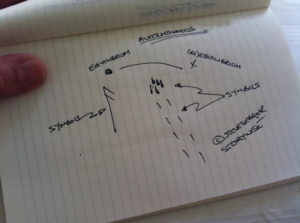
I honestly can’t remember exactly where I first drew this model from over a decade ago, but I do know it was a pattern I saw across autochthonous peoples . I see today that it aligns with ethnopoetics (Hymes), oral pedagogical traditions, and many semiotic approaches to myth and perception.
What this narrative design enables:
-
Meaning without imposed sequence or authorial closure
-
Symbols to function as prompts rather than answers
-
Interpretive work carried by the reader or listener
-
Narrative as a training of perception rather than message transmission
-
Sense-making that remains open, situated, and unfinished
Closing: narrative repertoire and complexity
Taken together, these forms show that stories generate coherence through complexity and agency in different ways, for different purposes. No single structure does — or can do — all the work.
This matters now more than ever. In conditions of polycrisis and polytelic challenge — where multiple, often conflicting aims must be held at once — a narrow narrative repertoire, such as reliance on the Hero’s Journey or any Western monoplot, becomes a serious constraint on sense-making and action.
When one story form dominates, other ways of sensing, coordinating, and acting are crowded out.
As I write in Ashby’s Law & Narrative Entrainment, systems with insufficient internal variety cannot respond adequately to environmental complexity. Narrative is no exception. Monoplot functions as a variety-killing attractor: familiar, reassuring — and ultimately limiting.
Expanding our narrative repertoire is therefore not aesthetic play. It is a complexity necessity.
Regaining agency, individually and collectively, means learning to un-entrain from inherited story grammars — and recognising when new and different forms of coherence need to be generated.
Until next time…
Be splendid.
— Steve
Leave a reaction and contribute to our blogcast
0 reactions


No comments yet — be the first!